


 Crown Win
When customers purchase new shoes, the shoe box is typically either kept for storage or discarded shortly after unboxing. For footwear brands and retailers, this raises a critical question: How can custom shoe box packaging be designed to not only meet long-term storage needs but also encourage consumers to reuse it repeatedly?
As a leading custom packaging supplier, Crown Win firmly believes that a well-designed shoe box is far more than just a single-use container. It should provide superior product protection during transit, help customers organize their storage spaces, and even evolve into a practical, reusable everyday item. This article takes a deep dive into how strategic design decisions—regarding structure, dimensions, and material selection—can transform an ordinary shoe box into a solution that is both practical and sustainable, creating lasting value for your brand.
Common Custom Shoe Box Structures: A Comparative Analysis
The structure of your shoe box directly impacts product protection, shipping costs, retail display effectiveness, and e-commerce operational efficiency. The following four popular design options each present a unique set of advantages and trade-offs:
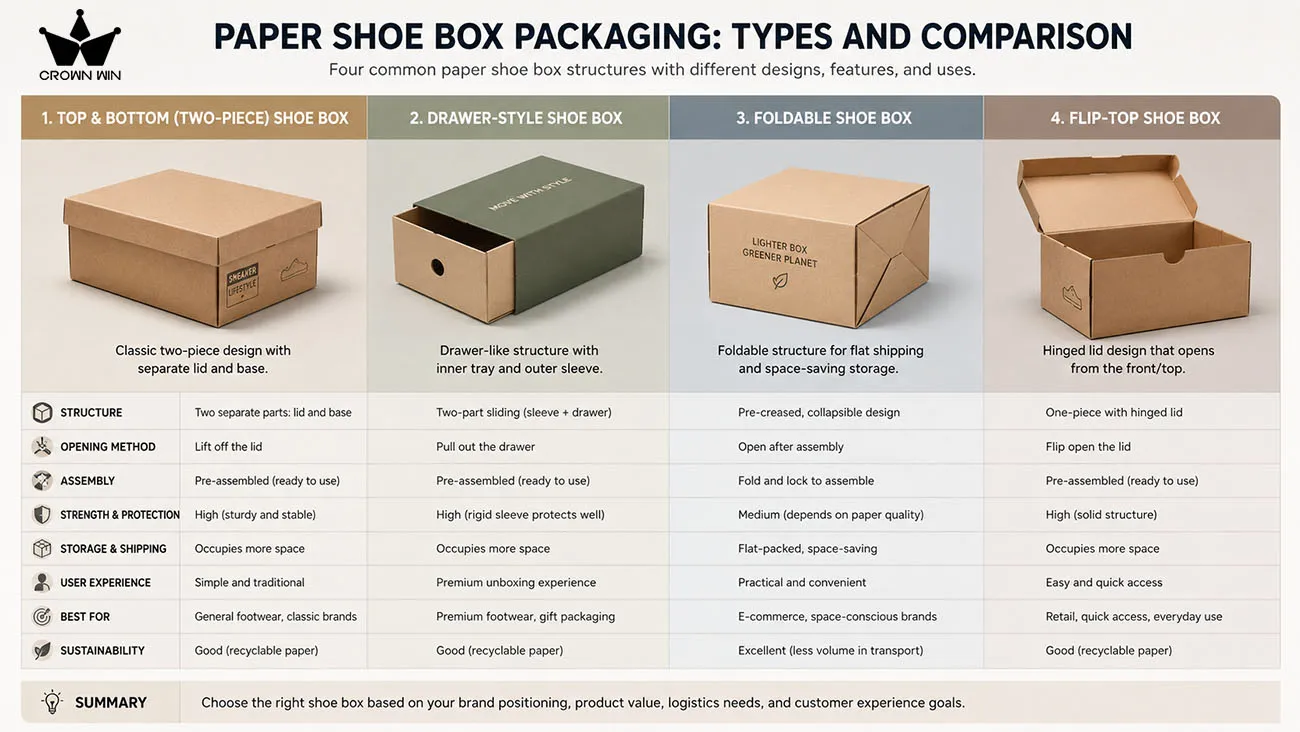
1. Lid-and-Base Shoe Boxes (Two-Piece Boxes)
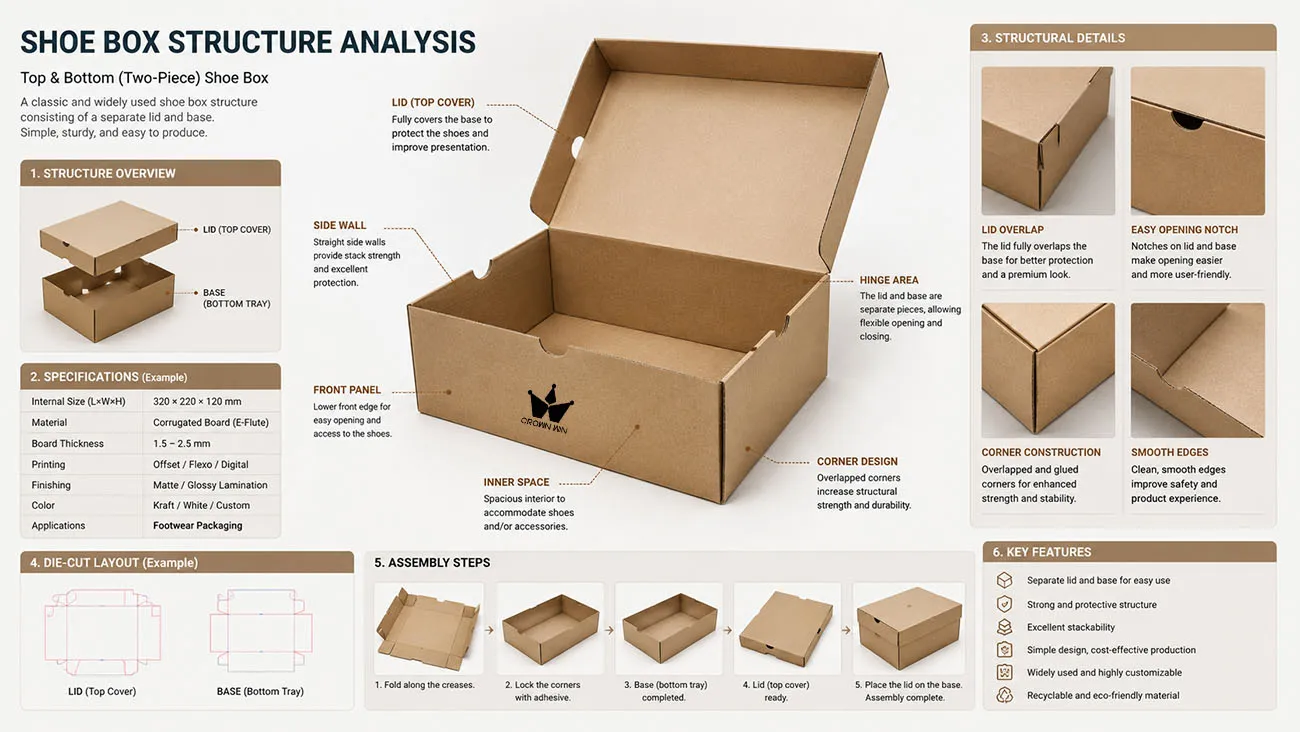
This traditional "lid-and-base" design, typically constructed from greyboard, offers excellent visual appeal for retail displays, making it a common choice for many premium brands. However, its two-piece structure can lead to uneven weight distribution during transit. To ensure product safety, thicker board materials are often required, which increases the box's weight, drives up shipping costs, and exacerbates its environmental impact. Additionally, their non-collapsible and bulky nature makes them relatively inefficient for e-commerce logistics. While they offer basic moisture resistance, they cannot fully prevent shoe deformation from compression when stacked.
2. Drawer-Style Shoe Boxes (Slide-Out Boxes)
Building upon the rigid two-piece structure, this design incorporates an additional sliding outer sleeve. Also typically constructed from greyboard, this design entails slightly higher manufacturing costs. Thanks to its fully enclosed structure, this type of shoe box delivers exceptional compression resistance, impact resistance, and moisture protection.
Consequently, it is highly favored by both athletic footwear and business shoe brands. Although it remains non-collapsible—resulting in higher shipping costs—it excels in retail display settings and works well for e-commerce logistics environments.
3. Collapsible Shoe Boxes
Primarily constructed from lightweight E-flute or B-flute corrugated cardboard, collapsible shoe boxes represent the optimal packaging solution specifically tailored for e-commerce logistics. Their fully collapsible design allows for up to 70% volume reduction during transit compared to rigid-structure shoe boxes, significantly lowering logistics and shipping costs. Their robust structural integrity minimizes damage risk during transportation, while their low material costs, retail suitability, and exceptional e-commerce utility make them the most cost-effective and sustainable packaging option available to online retailers.
4. Flip-Top Shoe Box Packaging
This integrated flip-top design minimizes both material usage and production costs and can be manufactured using either corrugated cardboard or greyboard. It not only conserves space during shipping and storage but also offers greater durability than traditional rigid boxes. Moreover, it is equally well-suited for physical retail stores and e-commerce applications. Its primary limitation is relatively poor moisture resistance. Therefore, when used in humid climates, it requires supplementary measures such as internal coatings, moisture-resistant liners, or desiccant packets.
Standard and Custom Shoe Box Sizes for All Footwear Types
Precise dimensional design ensures optimal product protection while enhancing overall shipping and storage efficiency.
The following are globally recognized industry-standard internal dimensions (Imperial/Metric):
Men's Standard Shoes/Sneakers: 13.0–14.0 × 8.0–9.0 × 4.0–5.0 inches (33–36 × 20–23 × 10–13 cm)
Women's Shoes/Flats/Heels: 12.0–13.0 × 7.0–8.0 × 4.0–5.0 inches (30–33 × 18–20 × 10–13 cm)
Children's Shoes: 8.0–10.0 × 5.0–6.0 × 3.0–4.0 inches (20–25 × 13–15 × 8–10 cm)
Boot Boxes (Ankle/Mid-calf/Tall): 14.0–15.0 × 10.0–12.0 × 5.0–6.5 inches (35–38 × 25–30 × 12–16.5 cm)
Sandals/Flip-flops/Minimalist Shoes: 11.0–12.0 × 7.0–8.0 × 3.0–4.0 inches (28–30 × 18–20 × 8–10 cm)
Important Note: Always customize dimensions based on your specific shoe designs, sole heights, and brand preferences to ensure a perfect fit and maximum protection.
Designing Sustainable, Reusable Custom Shoe Boxes
True sustainability extends far beyond merely using eco-friendly materials—it lies in creating lasting post-purchase value. At Crown Win, we focus on designing shoe boxes that customers actually want to keep, effectively reducing waste and enhancing brand loyalty through three key strategies:
Adjustable Internal Dividers: These allow customers to reconfigure the internal layout to suit different shoe styles, transforming what would otherwise be a single-use container into a versatile storage solution for closets, shelves, and under-bed spaces.
Practical Storage Components: Incorporating zippered pockets, protective liners, or dedicated compartments enables organized storage of socks, shoe care products, laces, and accessories, creating a comprehensive shoe care and organization system.
Modular, Detachable Structure: The packaging is designed to separate into two independent units—one dedicated specifically to shoe storage, and the other flexibly convertible into a stool, storage bin, or display stand. This design not only significantly enhances functionality but also fosters an emotional bond between the brand and the consumer, effectively encouraging repeated reuse of the packaging.
Conclusion
A well-designed custom shoe box is far more than a mere shipping container—it is a brand asset of enduring value. From structural design and precise dimensions to the selection of eco-friendly sustainable materials, every detail contributes to extending the packaging's useful life in the hands of your customers.
Partner with Crown Win Packaging Manufacturers to create premium shoe boxes that offer superior protection, minimize shipping costs and environmental impact, and consistently reinforce your brand image day after day. When consumers choose to keep and reuse your packaging, what would otherwise be a one-time expense transforms into a powerful driver for building long-term brand loyalty and generating positive word-of-mouth referrals.
If you have custom shoe box packaging requirements, contact us today to discuss your project needs and receive a free, no-obligation quotation.
 Mailer Box vs. Shipping Box: Choosing the Best Customized Packaging for Your Brand