


 Crown Win
For any brand worldwide, finding the perfect and affordable custom packaging box is a game between aesthetics, product protection, and budget. When you inquire with a packaging printing factory, you may be curious why there is such a large price difference between different projects?
In fact, the pricing of customized packaging is not imagined out of thin air, but a precise mathematical formula. As the source manufacturing factory, Crown Win Box Manufacturer today reveals the 9 core elements that determine the final factory price of customized packaging boxes.
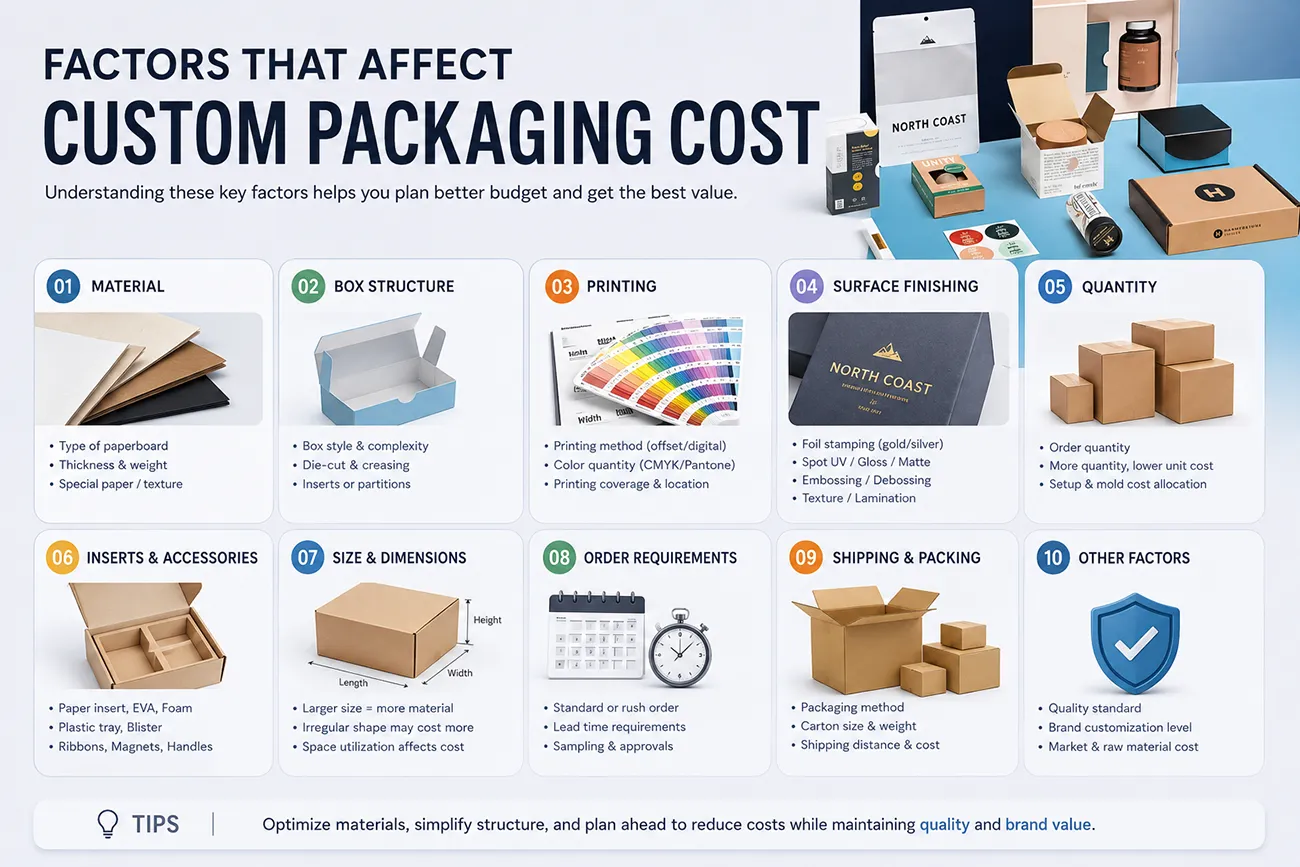
1. Production cost and quantity
The basis of packaging manufacturing is raw materials and fixed production costs, which are greatly influenced by your minimum order quantity (MOQ).
In the paper box printing industry, the early preparation stage, including the production of digital plates, machine adjustment, programmable CNC sampling machines, and adjustment of industrial offset printing machines, requires high fixed costs (i.e. start-up fees/plate loading fees).
Small batch production (100-500 pieces): The fixed start-up cost is spread out over a smaller quantity of products, resulting in a higher unit price for a single packaging box.
Large scale mass production (over 2000 units): The start-up cost is evenly distributed among thousands of products, and the shared cost of a single packaging is almost zero, thereby significantly reducing the unit price and maximizing the advantages of economies of scale.
2. Structural complexity
The design of the knife die structure of the packaging box directly determines the required manual and mechanical labor hours.
Standard folding cardboard boxes and corrugated mailing boxes: These types of packaging are usually die cut and glued using high-speed fully automatic box pasting machines. Due to its high degree of automation and minimal manual intervention, its price is very affordable.
Complex structural design: High end packaging (such as double door folding magnetic cardboard boxes, customized drawer boxes, or multi-layer high-end gift boxes) requires precise internal mechanical structures. This type of style often requires a combination of fully automatic corner positioning machines and manual assembly by skilled workers to ensure that the box body fits tightly and the positive and negative poles of the magnet are accurately attracted, which undoubtedly increases the structural cost.
3. Selection of raw materials
The choice of basic paper material directly determines the stiffness, texture, and final cost of the packaging box. Different packaging styles require matching paper of different grades and weights.
Firstly, white cardboard (also known as SBS single copper paper), with a common weight between 300gsm and 400gsm, has excellent printing color rendering and is the most ideal and cost-effective economic choice for folding paper boxes such as cosmetics and skincare products.
Secondly, for e-commerce mailing boxes and subscription gift boxes that pursue durability and budget friendliness, corrugated cardboard is usually used, with high-density E-tile and F-tile being the most commonly used, which can provide excellent compressive protection while effectively controlling material costs.
For high-end boutique gift boxes, perfume boxes and wig packaging, gray board paper must be used as the core support of hard boxes. The thickness of this material is usually between 1200gsm and 1800gsm. Although it is a premium core material with relatively high cost, it can give the packaging box an unparalleled luxurious texture and sturdy structure.
Finally, if you pursue the ultimate brand image, you can also choose to mount special texture paper on the outer layer of the gray board. This type of paper comes with a unique texture and advanced visual effects, often showcasing low-key luxury without the need for large-scale printing, making it a high image investment material for the high-end market.
4. Printing and surface treatment processes
Converting a blank cardboard into a brand's visual asset requires surface treatment. The more complex the post-processing technology, the higher the engineering cost.
Printing method: Traditional CMYK four-color offset printing can provide unparalleled color depth and delicacy for large-scale orders, but requires payment of plate fees; Digital printing is extremely fast in prototyping and small batch production, but the cost is too high for large-scale production.
Surface technology: Covering with protective matte or glossy film is the industry standard. However, more advanced visual effects such as 3D foil stamping, spot UV, embossing/debossing, and anti scratch coating require customized metal molds and increased machine operation sequence, which will increase unit costs.
5. Environmental protection and sustainability requirements
Priority should be given to FSC certified paper (sourced from responsibly managed forests), 100% post consumer recycled (PCW) grey board, and biodegradable soy eco-friendly ink, all of which require a rigorously audited supply chain. Although the premium for environmentally friendly materials was high in the past, with the standardization of green supply chains, the additional cost of choosing environmentally friendly packaging is now very small, but it can bring huge green premiums to brands.
6. Production lead time and factory operation cycle
In supply chain management, time is money. The standard factory delivery time includes: pre production sample confirmation, bulk raw material procurement, printing, surface treatment, die-cutting, assembly, and quality inspection.
If your brand is facing an urgent product release milestone and requires expedited production, the factory must adjust the existing production schedule, pay overtime wages to workers, or ship raw materials quickly. These adjustments will incur expedited service fees. Planning 4 to 6 weeks in advance is the best way to avoid such additional expenses.
7. Factory trust, international certification, and compliance
Why do the quotes of physical factories and certified suppliers at the source differ from those of unqualified small workshops or pure intermediaries in foreign trade? This involves production compliance and international standards.
An excellent manufacturer has invested significant capital in maintaining internationally recognized certifications, such as ISO9001 (Quality Management System), BSCI (Corporate Social Standards Certification), and SGS raw material environmental testing. These compliance frameworks ensure reasonable worker salaries, clean production environments, and non-toxic and safe packaging materials. Cooperating with factories that have passed the audit can eliminate the risks of customs detention, recall, and legal risks of products from the source, and this certification ensures the security of the long-term supply chain.
8. Comprehensive logistics and transportation costs (volume weight DIM Weight)
The true cost of packaging boxes does not end the moment they leave the assembly line. Due to the presence of DIM Weight, shipping and logistics costs often have a significant impact on your overall budget.
Assembled factory hard box: Transporting fully assembled hard gift boxes means you are paying expensive international sea or air freight to 'transport air', which can lead to skyrocketing logistics costs.
Foldable magnet hard box: Collaborate with manufacturers proficient in packaging structure engineering to develop foldable magnet box structures. This type of box can achieve 100% flat packed transportation, saving you up to 70% of storage space and cross-border transportation costs.
9. Quality Control (QC) and Inspection Standards
The last hidden variable is the severity of the factory's quality inspection process. Low price workshops may randomly check 1 out of 1000 boxes; Professional export-oriented manufacturing enterprises have full-time QC teams that perform multi-stage comprehensive quality inspections
Incoming Quality Control (IQC): Testing the moisture content, stiffness, and bursting resistance of paper.
Printing Online Control (IPQC): Using a digital spectrophotometer to strictly calibrate the Pantone color code, ensuring that there is no color difference in the bulk order.
Finished product sampling (OQC) after assembly: testing the adhesive strength, repeated folding and opening strength, and magnetic attraction force.
Implementing the 'zero defect' policy requires dedicated labor costs, but it ensures that every packaging box delivered to your overseas warehouse is impeccable.
Expert advice from Crown Win:
When optimizing the budget for customized packaging, don't just focus on the lowest unit price. Looking for a manufacturing partner who is truly proficient in packaging structure design. By scientifically improving packaging dimensions, selecting the most suitable paper grade, and transforming into a foldable space saving structure, you can significantly reduce your overall total cost of ownership while perfectly upgrading your brand. You can also avoid a series of production and transportation problems caused by low prices. If you are looking for a trusted packaging manufacturer, Crown Win will help your brand stand out in the market through rigorous structural design. Please feel free to contact us at any time for customized quotes directly provided by first-line factories.
 Premium Matte Cosmetic & Skincare Packaging Gift Boxes with Custom EVA Lining