



 Crown Win
How to choose a suitable box structure? For a brand, it is one of the most critical decisions. Most brands often ask us the same core question when purchasing packaging: why is the price of hard boxes more expensive than folding paper boxes for the same quantity?
As a professional packaging manufacturer and source factory, we are well aware that the price and cost difference between these two box types may appear quite significant.
Although a regular folding cardboard box may cost less than one dollar, a customized high-end hard box can easily reach a unit price of 3 to 10 dollars or more.
This price difference is not a malicious price increase, the fundamental reason lies in the materials, engineering, and logistics links. Next, Crown Win will provide a detailed analysis in this article on why hard boxes are generally priced higher - and why they are still the best choice for luxury brands.
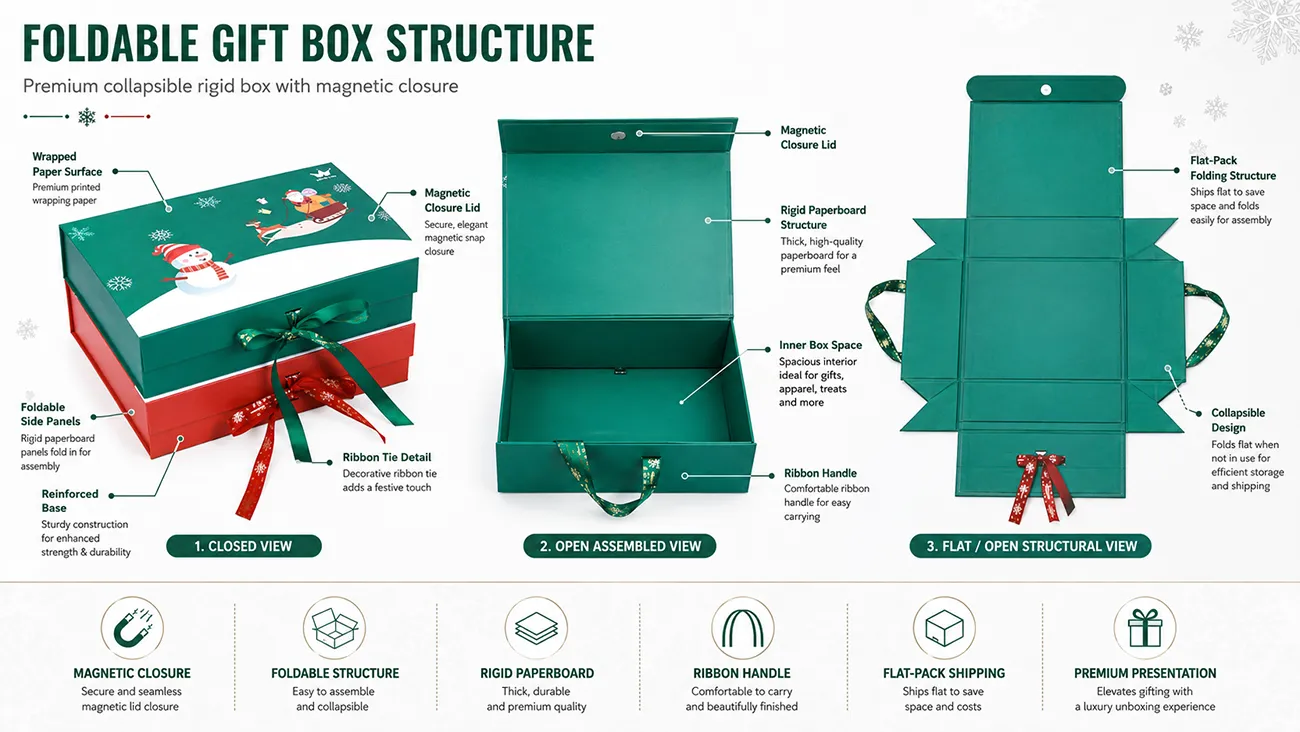
1. Materials and Structure
The primary reason for this cost difference lies in the actual materials used to construct these two types of boxes.
Folding Cartons: This type of cardboard box is made from a single sheet of thin cardboard (usually between 14pt and 28pt thick, approximately 0.3mm to 0.8mm). The machine directly prints and die-cutting on cardboard, and then folds it into shape.
Rigid Boxes/Set Up Boxes: Rigid boxes use a composite multi-layer structure. The core substrate is composed of thick, high-density industrial cardboard or gray board (usually 1.5 to 3.0 millimeters thick) - up to six times the thickness of a folding paper box. As this thick core substrate cannot be directly printed, an additional high-quality special paper, textured wrapping paper, or laminated offset paper must be selected to accurately coat and wrap it on the gray board as the skeleton.
Essentially, you are purchasing two layers of high-quality materials instead of one, which naturally increases the cost of raw materials.
2. Labor costs and structural complexity
Folding paper boxes can be regarded as masterpieces of modern automated production. The high-speed folding and gluing machine can process, fold, and glue tens of thousands of flat paper boxes per hour with minimal manual intervention.
The manufacturing of hard boxes requires a completely different and extremely precise assembly line.
[Gray board die-cutting] ➔ [Edge and corner bonding/reinforcement] ➔ [Coating paper with glue] ➔ [Manual/semi-automatic wrapping and folding]
Even with advanced semi-automatic packaging assembly lines, the manufacturing process of customized high-end hard boxes still relies heavily on manual labor:
Corner bonding: Flat gray boards must undergo indentation treatment and be folded into a three-dimensional tray shape, and then the corners are reinforced with heat activated tape before wrapping.
Wrapping and folding: To accurately align and adhere the patterned wrapping paper to the three-dimensional box frame, extremely precise calibration is required. For hard boxes with complex shapes or composed of multiple components, manual operators must perform folding, smoothing, and edge inspection to ensure that the surface of the box is free of bubbles and the edges are not misaligned.
Accessories integration: the integration of invisible magnetic snap fastener, ribbon, or customized lining (such as high-density EVA foam, molded pulp tray, flocking lining, etc.) will add additional processes to the production line - and these processes cannot be completely replaced by fully automated equipment.
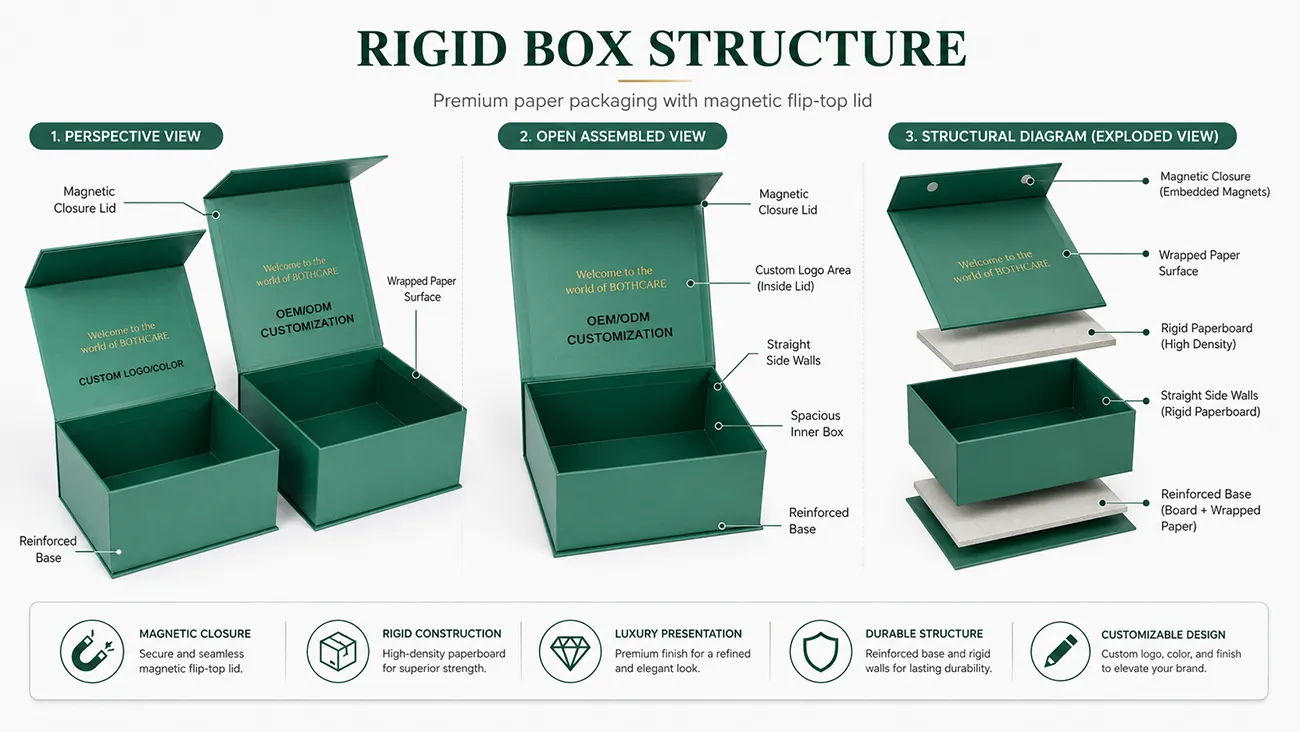
3. Warehouse management and transportation issues caused by volume and weight
This is an implicit cost that many buyers easily forget.
Folding paper boxes are stored completely flat during transportation and storage. Only one pallet is needed to stack tens of thousands of flat packaging folding paper boxes, which makes its transportation cost extremely low.
When traditional hard boxes arrive at your warehouse, they are usually in a fully assembled state. Due to the inability of the hard box to fold and flatten, you are actually paying for the air, as the material thickness of the hard box is high, the volume is relatively large, and the storage and transportation costs are high.
Freight calculation knowledge: In international freight, freight is usually calculated based on volumetric weight (i.e. the volume of space occupied by the goods) rather than actual weight. The assembled hard box will occupy a huge warehouse space and container capacity, significantly increasing your single product cost.
*Note: In order to bridge this gap, modern structural designers often design foldable magnetic hard boxes - a hybrid structure that can provide the unique texture of hard boxes and fold flat, thereby significantly reducing international transportation and storage costs.
4. Mold and setup costs for small-scale production
Due to the involvement of various mechanical equipment in the manufacturing process of hard boxes, such as die-cutting machines, slotting machines, corner wrapping machines, and wrapping assembly lines, the required equipment setup time and structural engineering preparation work are often time-consuming and complex before the first box is officially produced.
Each unique size adjustment requires a dedicated set of mechanical molds to be configured. For small batch orders (such as 1000 units), these fixed structural setup costs will be allocated to a smaller number of finished products, resulting in significantly higher individual costs compared to large-scale production of folding paper boxes.
Conclusion: When is it worth buying a hard box?
Although folding paper boxes are very suitable for large quantities and fast turnover of consumer goods, customized hard boxes can perfectly showcase product quality and brand tone to consumers. For luxury goods with retail prices exceeding $50, the consumer group they come into contact with, the solid structural touch, and excellent protective performance not only fully justify their high manufacturing costs, but also conform to the consumption habits of this group of consumers.
As a trusted OEM/ODM paper packaging manufacturer, Crown Win provides one-stop services from free design, sample production to mass production. Our strict full process quality control ensures that every packaging box meets your specific requirements, whether you need a hard box or a folding box.
Are you ready to enhance your brand image with customized packaging? Contact us immediately for an exclusive free quote.
 Crown Win in depth analysis: What are the factors that affect the price of customized packaging boxes?